 Exogenous agents in the environment impose various forms and extent
of stress on an organism. The varied forms include radiation, chemical and
biological. The consequences of stess may occur at levels ranging from the physiological to the genetic. Among the genetic responses, normally silent
and quiescent genes may become active under stress. Thus stress-induced
gene activation is an intriguing phenomenon.
Exogenous agents in the environment impose various forms and extent
of stress on an organism. The varied forms include radiation, chemical and
biological. The consequences of stess may occur at levels ranging from the physiological to the genetic. Among the genetic responses, normally silent
and quiescent genes may become active under stress. Thus stress-induced
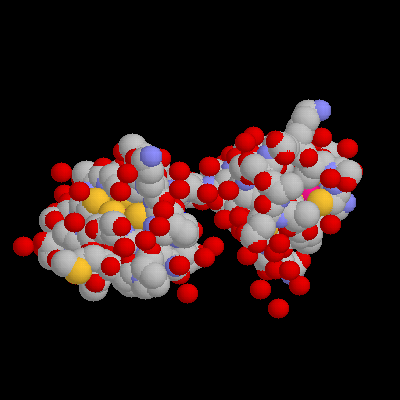
gene activation is an intriguing phenomenon.The focus of our laborotory is on heavy metals as a form of stress causing agents, particularly the transition IB and IIB metals, which include the economically precious siler and gold, the nutritionally essential zinc and copper, as well as the industrially important, yet biologically toxic, cadmium and mercury. These metals are chosen for study because they share a common feature of reacting to a class of gene products, metallothionein. Cysteines are the most conserved and abundent residues in the metallothioneins. It directly binds metal and has a crutial role in the formation of metal binding cluster. (See the cysteines in the metallothioneins)
Metallothionein binds metals avidly and its synthesis is induced by some of the metals it binds, as well as by other stress conditions. Its function may thus be pleiotropic, involving metal detoxification, homeostasis, and transport in theform of a metal donor/receptor.
We study structure constrains for the function of metallothionein through the use of recombinent DNA techniques. Metallothionein cDNA sequences from plants and animals are identified and isolated. They are subjected to site-directed mutagenesis by substitution, insertion or deletion and the resultent mutants cloned into ecoli-yeast shuttle vectors and expressed in a yeast host, whose endogenous thionein genes have been previously disrupted. With this expression system, the ability of the altered metallothioneins to convey metal resistance and to bind metals is studied with transgenic assays. Physicochemical approaches which include chemical and enzymatic accessibility, circular dichroism and nuclear magnetic resonance spectrometry are used to study muteins, the mutant proteins, for consequential and non-consequential structure changes.
Additional studies are being conducted in order to elucidate the nature of induction of this family of stress inducible genes at the level of genomic organization and transcriptional regulation in eukaryotic cells.

