A biosynthetic method has been developed that makes possible the site-specific incorporation of a large number of amino acids and analogues within proteins. In this approach, an amber suppressor tRNA chemically aminoacylated with the desired amino acid incorporates this amino acid site specifically into a protein in response to an amber codon introduced at the corresponding position in the protein's DNA sequence. Using this method, precise changes within a protein can be made to address detailed structure-function questions. A series of fluorinated tyrosine analogues and linear, branched, and cyclic hydrophobic amino acids have been used to determine the impact of hydrogen bonding and hydrophobic packing, respectively, on protein stability. Glutamate analogues and conformationally restricted amino acids have been used to probe the mechanisms of staphylococcal nuclease and ras. In addition, this technique has been used to construct photocaged proteins and proteins containing photoaffinity labels, spin labels, and isotopic labels at specific positions in the protein sequence suitable for biophysical studies.
Annu Rev Biophys Biomol Struct 1995;24:435-62
Probing the structure and mechanism of Ras protein with an expanded genetic code. Chung HH, Benson DR, Schultz PG Department of Chemistry, University of California, Berkeley 94720.
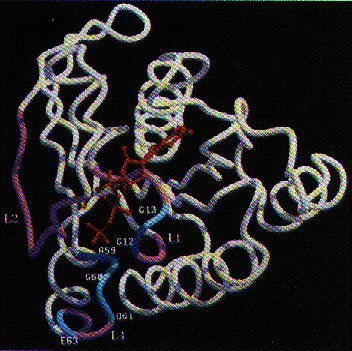
Mutations in Ras protein at positions Gly12 and Gly13 (phosphate-binding loop L1) and at positions Ala59, Gly60, and Gln61 (loop L4) are commonly associated with oncogenic activation. The structural and catalytic roles of these residues were probed with a series of unnatural amino acids that have unusual main chain conformations, hydrogen bonding abilities, and steric features. The properties of wild-type and transforming Ras proteins previously thought to be uniquely associated with the structure of a single amino acid at these positions were retained by mutants that contained a variety of unnatural amino acids. This expanded set of functional mutants provides new insight into the role of loop L4 residues in switch function and suggests that loop L1 may participate in the activation of Ras protein by effector molecules.
Science 1993 Feb 5;259(5096):806-9
Unnatural amino acid mutagenesis, in combination with molecular modeling and simulation techniques, was used to probe the effect of side chain structure on protein stability. Specific replacements at position 133 in T4 lysozyme included (i) leucine (wt), norvaline, ethylglycine, and alanine to measure the cost of stepwise removal of methyl groups from the hydrophobic core, (ii) norvaline and O-methyl serine to evaluate the effects of side chain solvation, and (iii) leucine, S,S-2-amino-4-methylhexanoic acid, and S-2-amino-3-cyclopentylpropanoic acid to measure the influence of packing density and side chain conformational entropy on protein stability. All of these factors (hydrophobicity, packing, conformational entropy, and cavity formation) significantly influence protein stability and must be considered when analyzing any structural change to proteins.
Science 1992 Jun 26;256(5065):1798-802
Staphylococcal nuclease is an enzyme with enormous catalytic power, accelerating phosphodiester bond hydrolysis by a factor of 10(16) over the spontaneous rate. The mechanistic basis for this rate acceleration was investigated by substitution of the active site residues Glu43, Arg35, and Arg87 with unnatural amino acid analogs. Two Glu43 mutants, one containing the nitro analog of glutamate and the other containing homoglutamate, retained high catalytic activity at pH 9.9, but were less active than the wild-type enzyme at lower pH values. The x-ray crystal structure of the homoglutamate mutant revealed that the carboxylate side chain of this residue occupies a position and orientation similar to that of Glu43 in the wild-type enzyme. The increase in steric bulk is accommodated by a backbone shift and altered torsion angles. The nitro and the homoglutamate mutants display similar pH versus rate profiles, which differ from that of the wild-type enzyme. Taken together, these studies suggest that Glu43 may not act as a general base, as previously thought, but may play a more complex structural role during catalysis.
Science 1993 Sep 17;261(5128):1578-81
PCL 10/18/1998